
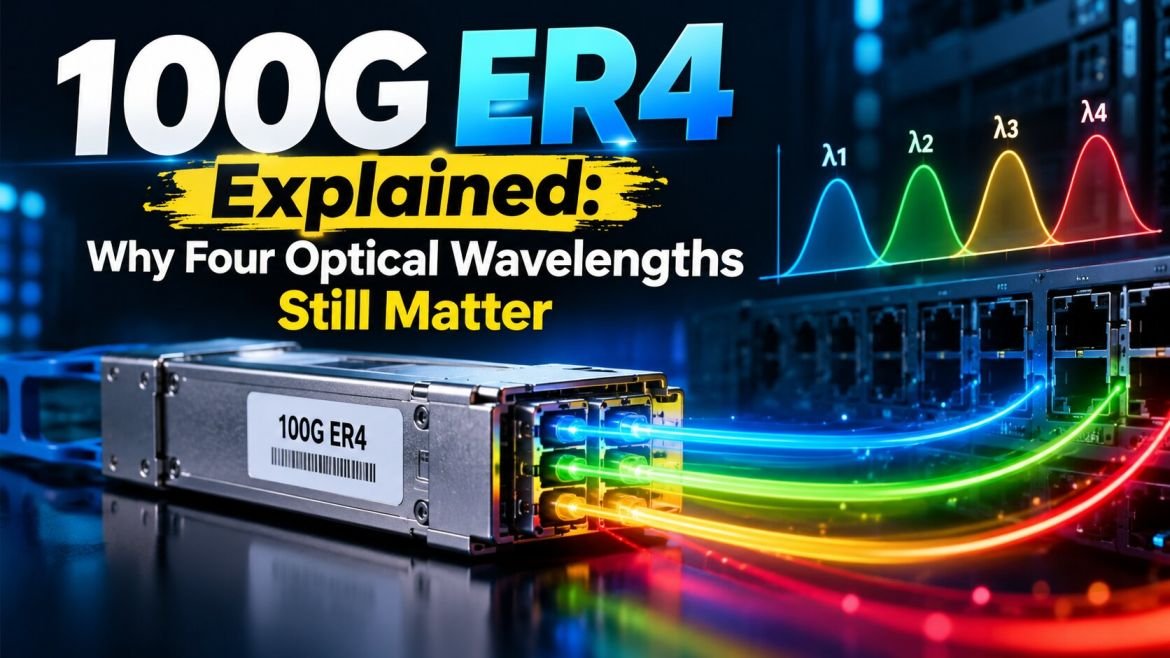
A 100G optical link does not necessarily mean one optical signal carrying 100 Gb/s. The 100G ER4 architecture takes a different approach: it divides the total bandwidth across four optical wavelengths, with each lane carrying approximately 25 Gb/s. These four channels are then multiplexed onto a single pair of single-mode fibers. This design became a practical way to extend 100G Ethernet beyond the reach of short-reach multimode solutions while keeping the optical technology relatively mature and manageable.
Why 100G ER4 Uses Four 25G Optical Lanes
The key idea behind ER4 is parallel optical transmission. Instead of asking a single laser and receiver to handle the entire 100G payload, the module uses four independent 25G optical channels. Each transmitter operates on a different wavelength in the 1310 nm region, and a WDM multiplexer combines the four optical signals into one fiber.
At the receiving end, a WDM demultiplexer separates the combined signal back into four wavelengths. Each wavelength is then detected and converted back into an electrical data stream. The result is a 100G connection carried over a standard duplex single-mode fiber pair.
This architecture also keeps each optical lane within a signaling range that was well established when 100G ER4 was developed. IEEE 802.3ba’s original 40 km ER4 architecture used four 25G optical channels, with EML transmitters and PIN-based receiver paths supported by optical amplification in the design.
Why Not Simply Transmit 100G on One Wavelength?
A single-wavelength 100G design sounds simpler, but the optical and electrical requirements become considerably more demanding. At the time ER4 was developed, operating an individual optical channel at 100 Gb/s would have required significantly more advanced components and tighter control of bandwidth, dispersion, transmitter characteristics, and receiver sensitivity.
Splitting the aggregate rate into four 25G channels offered a more practical engineering path. Each optical lane could use mature 25G-class components while WDM technology handled the aggregation. This reduced the technological burden on individual lasers and receivers while still achieving 100G over single-mode fiber.
The four-lane approach also fit naturally into the broader 100G ecosystem. Components, testing methods, optical packaging, and manufacturing processes for 25G-class channels were already developing rapidly, making a four-channel architecture easier to commercialize and scale.
The Role of EML and PIN in Extended-Reach Links
For extended-reach transmission, the optical source and receiver must maintain adequate performance after traveling through kilometers of single-mode fiber. EML technology provides stronger control of the optical signal than a basic directly modulated laser, helping manage the bandwidth and dispersion requirements of longer links.
On the receive side, PIN photodiodes provide a relatively mature detection technology. Depending on the implementation and required link budget, additional optical amplification or more sensitive receiver designs can be used to extend the practical reach. IEEE development materials show the evolution of ER4 receiver approaches as 25G-per-lane technology matured.
Why the Four-Wavelength Architecture Still Matters
The importance of 100G QSFP28 ER4 is not simply that it can reach tens of kilometers. Its real value lies in how it combines four relatively manageable optical channels into a single 100G interface.
The architecture established a practical balance between optical performance, component maturity, link reach, and manufacturing complexity. It also demonstrates an important principle in optical networking: higher aggregate bandwidth does not always require one optical channel to carry the entire data rate. Parallel lanes combined through WDM can provide a more practical path to higher capacity.
For 100G deployments that require single-mode fiber and extended reach, the four-wavelength ER4 architecture remains a useful example of how optical networking evolved by combining mature technologies rather than relying on a single high-speed optical channel.